In twenty-five years of building enterprise systems, I can’t remember a single business problem that was caused by a lack of general knowledge.
The problems were always about our knowledge. Which customer is behind on payments. Which orders a late shipment will hit. Who is allowed to approve a credit change during month-end close. The answers existed, but they were spread across four systems and two people’s heads.
That is why I am not excited when someone tells me the next AI model will be bigger. Bigger is not what most companies are missing. They are missing a second brain.
The first brain is brilliant, and a stranger to your business
Today’s large language models are what I call the first brain. They have read a huge share of the public internet. They write well, they reason surprisingly well, and they know a little about almost everything.
What they don’t know is you.
Ask a public model about your credit policy, your network or your top customers and it will still answer. It will answer fluently and with confidence. But it is answering from patterns, not from your records, because it has never seen your records.
I find it helps to think of the first brain as a very good outside consultant. Clever, well read, available at short notice. But the consultant knows nothing about your company until you hand over the files, and charges for every hour of thinking.
Plausible is the most expensive kind of wrong
When a model doesn’t have the facts, it fills the gap with something plausible. That is the part that worries me most.
A wrong answer that looks wrong gets caught. A wrong answer that sounds right gets forwarded, pasted into a report and acted on. In a business, plausible is the most expensive kind of wrong, because nobody stops to check it.
Making the model bigger doesn’t fix this. A bigger model that is guessing is still guessing. It just guesses more elegantly.
What fixes it is giving the model something real to read.
What a second brain actually is
Ask any leader to explain their business and they will go to the whiteboard. Customers here. Orders there. Invoices at the end. Then they will say “but only if…” and add a rule.
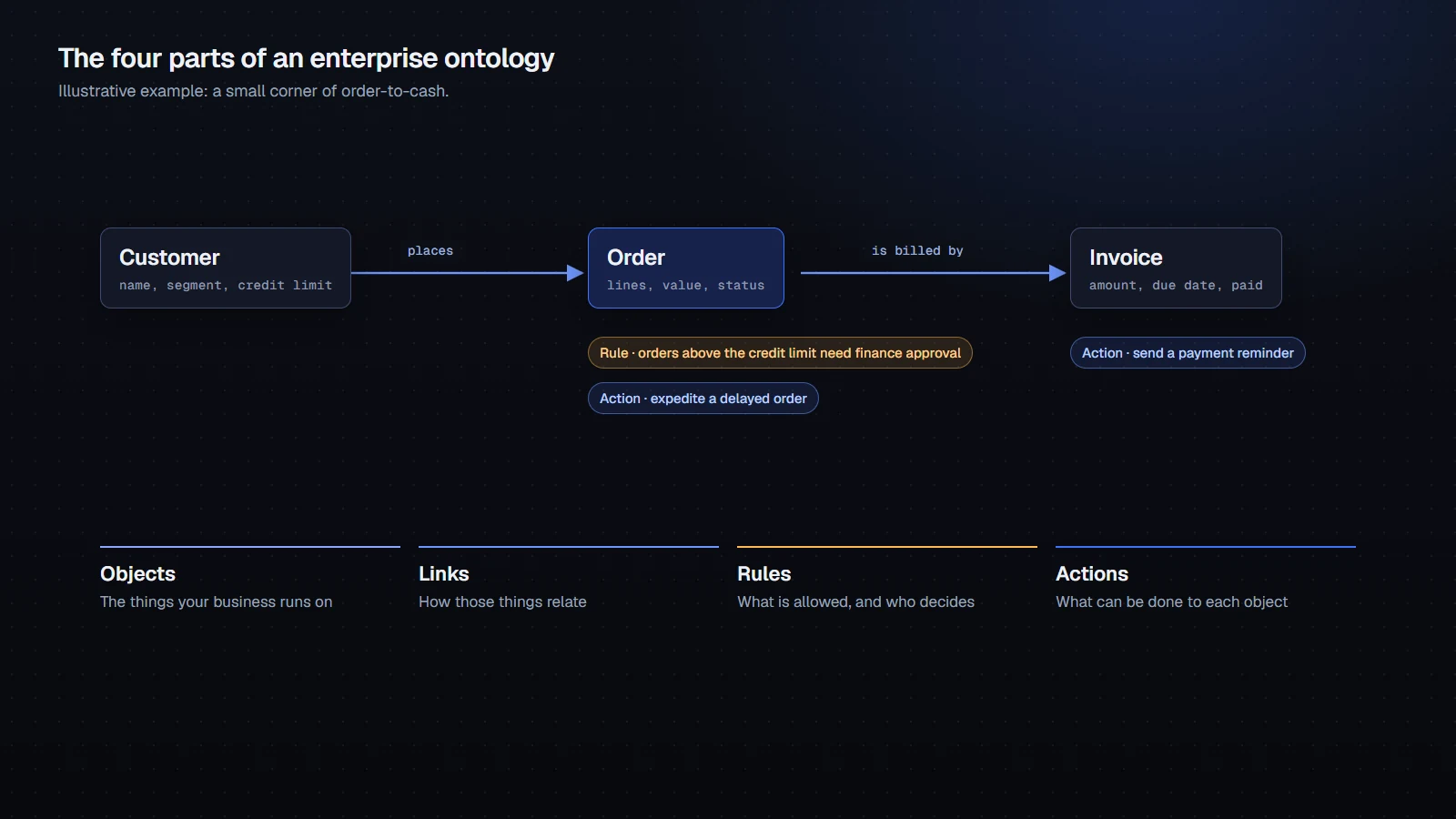
That whiteboard is an ontology. In plain terms, it has four parts:
- Objects: the things your business runs on. Customer, order, invoice, product, cell site.
- Links: how those things relate. A customer places an order. An order is billed by an invoice.
- Rules: what is allowed, and who decides. “Orders above the credit limit need finance approval.”
- Actions: what can be done to each object. Send a payment reminder. Expedite a delayed order.
The second brain is that whiteboard, made precise enough for software and kept up to date with your real systems. Your systems hold the data. The ontology holds the meaning.
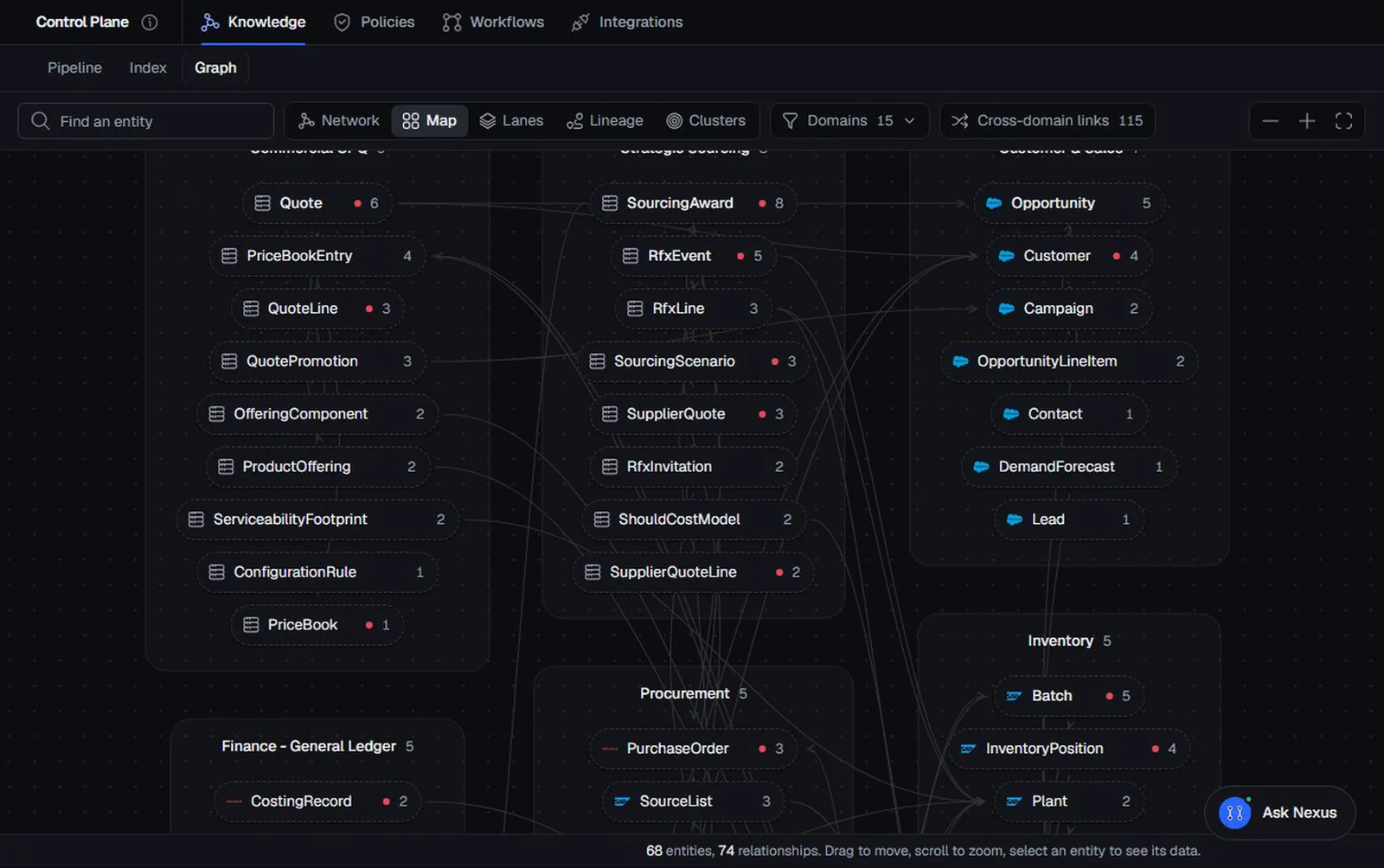
None of this requires moving your data. In NexusAI, the data stays in the CRM, the ERP and the other systems it came from. The ontology describes it and queries go to the source.
How one question travels through the second brain
Here is what changes when AI works through the ontology instead of from memory. Take a simple question from an operations manager:
”Which customers are affected by the delayed shipment?”
- The question arrives in plain language. Nobody has to know which system holds what.
- The facts are fetched, not imagined. A query walks the graph: shipment to orders, orders to customers. Every object comes from a real record.
- The rules are read by name. The policies attached to those objects are looked up, not remembered.
- A model writes the answer. Its job is language: turning verified facts into a clear sentence.
- The answer carries its sources. Each customer it names links back to the record behind it.
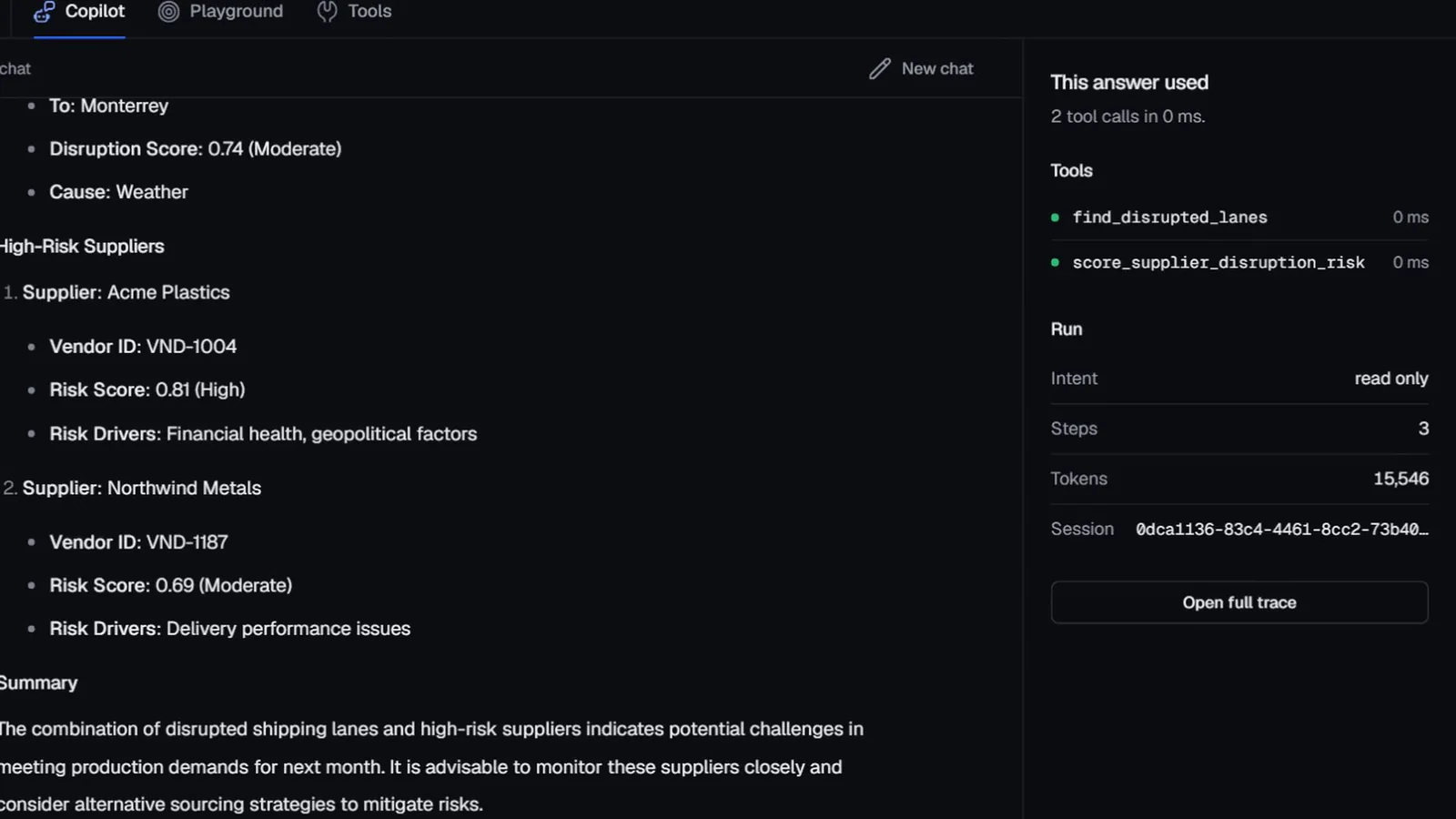
You can see that trail in the product. In the example below, the copilot was asked about customers with overdue invoices. Next to the answer, a panel shows exactly what it used: which tools ran, how long each took, and that the run was read-only.
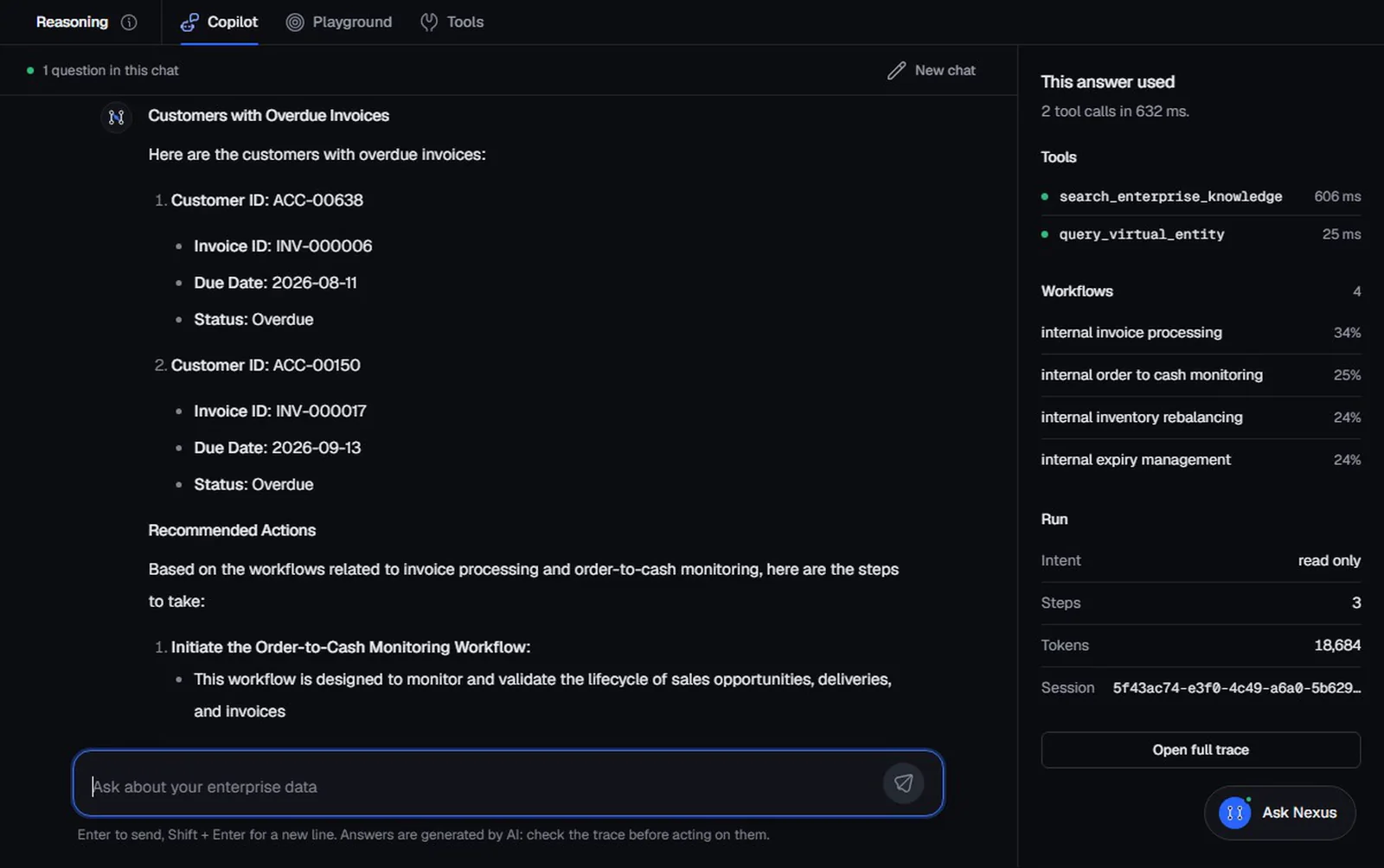
That panel matters more than the answer itself. When someone in finance asks “based on what?”, the reply is on the screen instead of in a support ticket.
Rules the model reads, not remembers
The second half of the second brain is the rules.
In most companies, policies live in PDFs, in email threads and in the memory of the people who wrote them. An AI that has to remember your policies will get them wrong sooner or later. An AI that reads them, by name, every time, can’t drift from them.
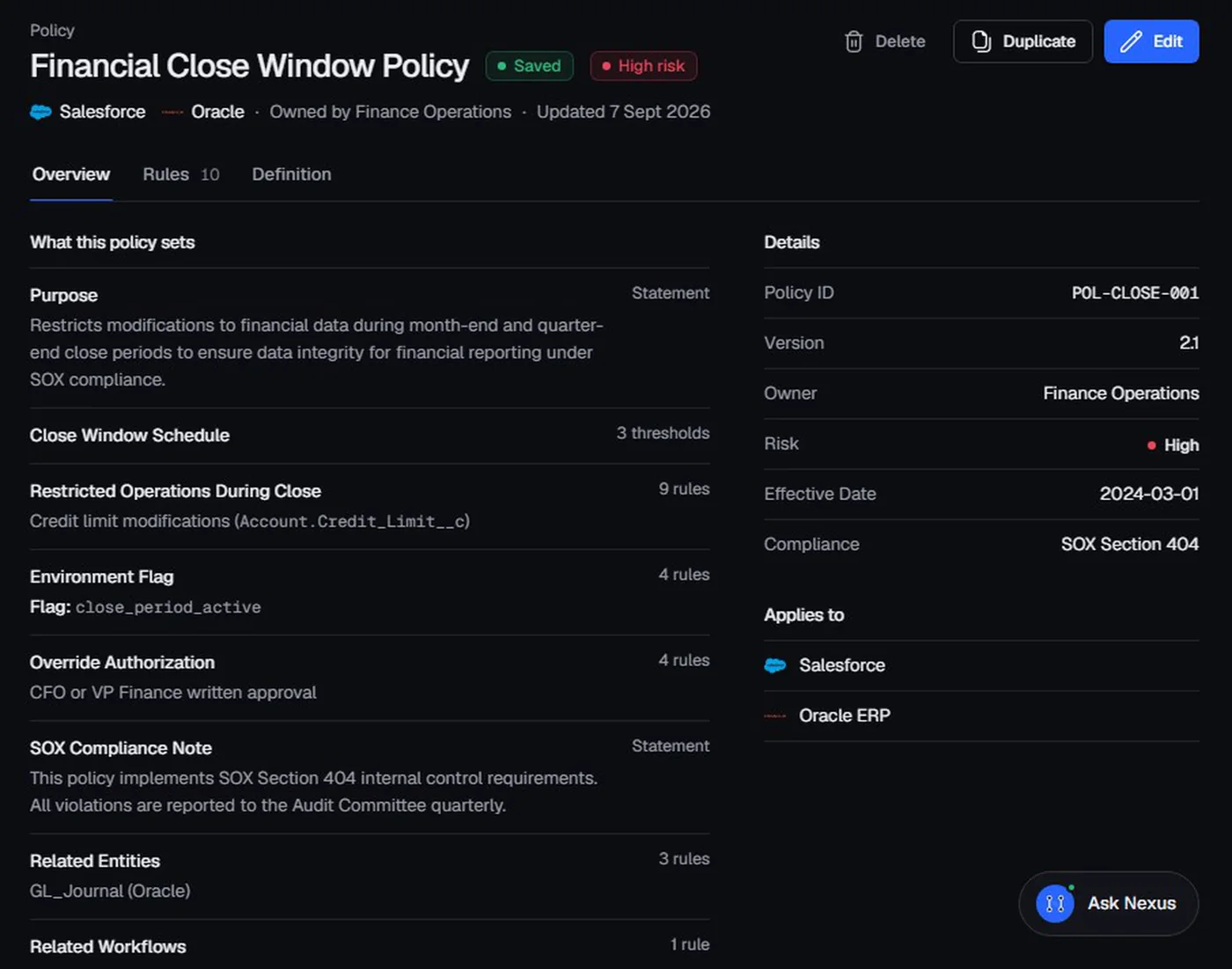
Look at the example above. The policy restricts changes to financial data during month-end close. It names an owner (Finance Operations), a risk level, the systems it covers and the override rule: written approval from the CFO or VP Finance. An auditor can read it. So can the AI, before it suggests anything.
Why the model can be smaller
Once the knowledge lives in the graph and the rules live in the policies, something useful happens. The model no longer needs to know everything. It needs to read well and stay on the page.
That has three side effects we care about:
- It can run inside your company. A smaller model fits on your own servers or a sovereign cloud, so your data doesn’t leave the building to get an answer.
- Each answer costs less. You are not paying a giant model to recall facts it was never going to get right.
- Mistakes are traceable. When an answer is wrong, you can see which fact or which step was wrong, and fix that, instead of hoping the next model version behaves better.
So the question I ask leaders is not “which model are you using?” It is “what does your model know about you?”
Rent general intelligence. Own business intelligence.
I am not against the first brain. Large models are remarkable, and the consultant in my analogy is genuinely useful.
But there is a difference between renting general intelligence and owning the knowledge your business runs on. The first can be swapped every year. The second is built up over time: every object you model, every rule you write down, every action you approve makes it more valuable. And it stays yours.
You need both. Only one of them belongs to you.
Where to start
You don’t need a two-year programme to begin. If I were starting tomorrow, I would do three things:
- Pick one decision that hurts. Late payments, a noisy alarm queue, a forecast nobody trusts. Start there, not with “AI strategy”.
- Draw that corner of the business. The five to ten objects involved, how they link, and the two or three rules that govern them. If you can put it on a whiteboard, it can be modelled.
- Give the AI only defined actions. Decide what it may read, what it may suggest and what needs a person’s approval. Write that down before anyone writes a prompt.
Do that once and the second use case is cheaper than the first, because the objects and rules are already there.
If you want to see what this looks like on real screens, take our two-minute product tour, or score your organisation with the sovereign AI readiness checklist.
Frequently asked questions
What is a “second brain” for an enterprise?
It is an ontology, a working model of your business. It holds your objects (customers, orders, invoices), the links between them, the rules that govern them and the actions people and software are allowed to take. AI reads from it instead of guessing.
Does a second brain replace large language models?
No. The language model still writes the answer. The difference is that the facts come from your systems and the rules come from your policies, so the model only has to read and explain, not remember.
Why can a smaller model be enough?
When the facts are fetched from the knowledge graph, the model’s job is language, not knowledge. A smaller model can do that well, and it can run on your own servers.
Do we have to move our data to build one?
No. NexusAI reads data where it already lives, through connectors to systems such as your CRM and ERP. The ontology describes the data; it does not copy it into a new store.